For companies
Tell us about your business, the process you want to connect and the systems you already use. The first discussion would define the pilot scope, responsibilities, integration requirements and commercial terms.
Discuss a company pilot
Coming soon · White-label platform
FACE Corporate Engine is designed to connect production, sales and finance records across a company’s existing systems. Its purpose is to create a traceable view of the business, with optional financial services and a corporate digital currency under the company’s own brand.
For manufacturers, technology companies and enterprise groups. FACE provides the software foundation; selected partners provide the financial services.
Mining begins only when real production grows and that growth can be verified.FACE Mining is not conventional coin mining and it is not computation for its own sake. The Corporate Engine verifies measurable development in production, productive capacity, goods and services, and records that development in the Corporate Value Chain. Mining follows verified economic growth.
The proposed process starts with agreed measures and a comparison period. Production records, delivery confirmations and financial records would be checked together, with returns, cancellations and duplicate entries accounted for. The record would distinguish physical output, sales, collected revenue and changes caused by prices or exchange rates.
Illustrative production example: a factory increases accepted output from 1,000 to 1,100 comparable units over equivalent periods. Supporting records establish the additional 100 units and the 10% volume increase. Published currency rules would then determine whether that verified change qualifies for issuance and how any new coins are allocated.
Verification would combine source records, cross-checks and accountable review. Recording an event on a blockchain preserves a record; confirming the underlying production still requires evidence. “FACE Mining” describes the proposed economic rule, while the blockchain’s transaction validation is a separate function.
Every enterprise already creates a value chain. FACE makes it continuous and verifiable.The Engine connects the economic events that are usually separated across procurement, production, intellectual property, logistics, sales and finance. The result is a living Corporate Value Chain showing where value came from, what the company added, what was sold, what was paid and how capital moved forward.
The initial focus is large manufacturers, technology and AI businesses, and groups operating across multiple entities or countries. The Engine is intended for situations where a single order, product or service passes through several systems and management needs a reliable view across them. Suppliers and smaller partners could connect the relevant part of their activity.
Follow one customer order. Link the materials purchased, the production batch, the shipment, the customer invoice and the payment received. Operations could trace a delivery problem; finance could see which invoice remains unpaid; management could compare the order’s recorded costs with its sales value. That connected view would make the underlying data useful before a cryptocurrency is introduced.

Connect existing systems. Follow the same activity from order to payment.FACE Corporate Engine is designed as a white-label software layer above the company’s operational systems. It would connect their records into one traceable Corporate Value Chain, highlight discrepancies and make reviewed information available to authorised teams and selected partners.
White label means the company would present the service under its own name and visual identity. Its customer experience, access roles, connected systems and currency programme would be configured around its business. FACE would provide the underlying Engine and coordinate the agreed software integrations.
A deployment could include the company’s logo, colours, languages and branded interfaces for its teams, employees or customers. Wallet and card experiences could carry the company’s branding where the relevant partner programme supports it.
The company would define its commercial offer and approve its operating rules. FACE would provide the software foundation under the agreed licence and implementation scope. Each financial programme would identify its actual card issuer, payment provider, custodian and other service providers. The participating company or its designated issuer would be identified in the currency programme.
One everyday example
An invoice covers 110 units, but the delivery receipt records 100. The Engine would flag the mismatch and keep that delivery in review. A responsible employee would investigate timing, returns or an incorrect entry before the records were treated as matched.
The first measurable result: follow a real order from purchase to payment, identify unresolved gaps and compare the time needed to produce that view with the company’s current process.
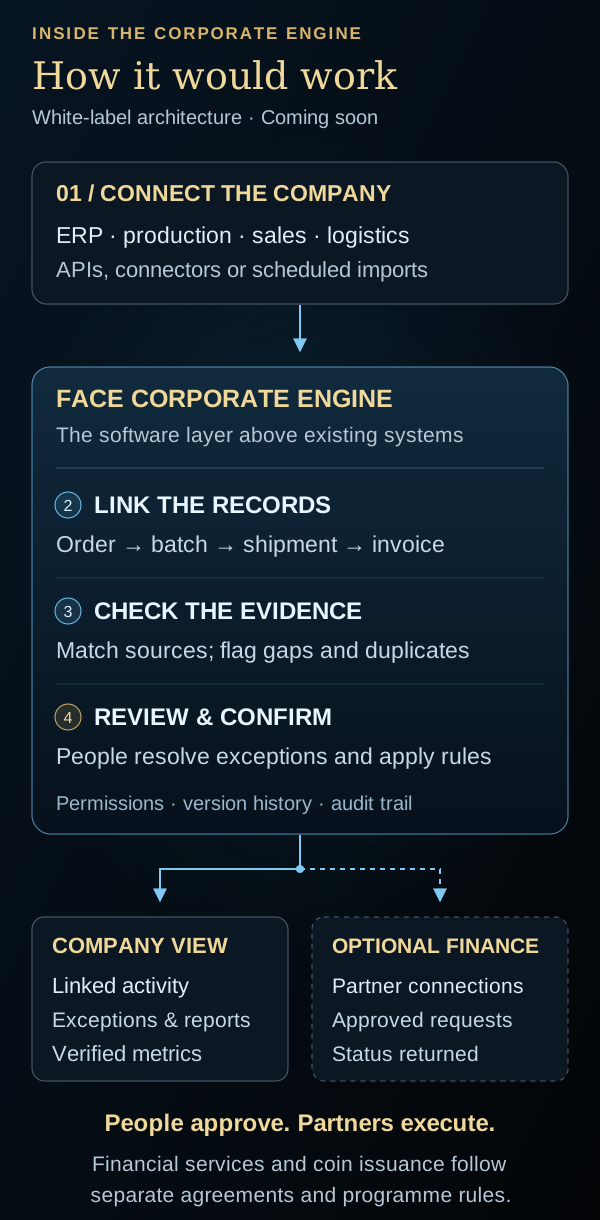
These are proposed views, not screenshots of a deployed product. Supported connections, update frequency and review responsibilities would be agreed for each implementation. A matched digital record still needs reliable source evidence; matching alone does not prove that production occurred.
The Value Chain becomes useful when it can interact with finance.The Corporate Fintech layer can connect payments, treasury, settlement, digital assets, exchange and capital management to the same verified economic history. The goal is not a second accounting system. It is one financial layer connected directly to what the company actually produces and creates.
Proposed personal fintech layer
A company’s financial services could serve employees and ordinary customers, including people who do not work for it. The everyday experience would be simple: add money, keep a payment balance and pay for goods and services with a company-branded card wherever its card network is accepted.
Crypto would be a choice. A customer could use the ordinary payment features without buying a token. Employees could choose to convert part of their pay, and cardholders could opt into crypto rewards where available.
FACE would provide the software and connections. Banking, custody, currency conversion and card issuance would be delivered by selected financial partners. The illustrated card represents the proposed payment service; product terms and availability would depend on those partners.
| Examples | How the model works |
|---|---|
| Gemini Crypto.com US credit card | Credit card purchases with crypto rewards. This shows how crypto can be an extra benefit attached to familiar card spending. |
| Coinbase Card MetaMask Card | Spend an existing balance: dollars or supported crypto with Coinbase Card, and supported wallet assets with MetaMask Card. These are closer to the proposed top-up-and-spend experience. |
| Nexo Card | Choose debit spending or credit secured by crypto assets. Borrowing adds collateral requirements and market risk; it is a separate feature from spending your own money. |
Product models checked against the linked official pages on 19 September 2026. Availability and terms vary by country. These are market examples, not announced FACE partners.
The proposed FACE connection is between the enterprise’s economic activity, payments to people and their everyday spending. The card and wallet would make that financial layer useful outside the company as well.
An official company cryptocurrency with a market-determined price.The proposed model is a freely circulating cryptocurrency formally issued or authorized by the participating company under a published programme. Eligible people outside the company would be able to buy, hold, transfer and sell it through supported services and markets. Its price would float with market supply and demand. The Engine would document the company’s economic activity; the currency’s published design would define its connection to that activity, its issuance rules and holders’ rights.
Each white-label deployment would have a company-specific currency programme. The Engine would provide the record and calculation workflow; the programme would define the decisions that authorise an actual issue.
A reason to use it: the company could offer defined service access, discounts or rewards, funded under its commercial programme. People outside the company could buy and use the coin through supported services. Demand and market price would still develop independently of the issuance calculation.
The formula, issue quantities, allocations and practical benefits would be agreed and published for each company before launch. The white-label Engine provides a configurable framework; those parameters are not fixed by this presentation.
Proposed balance structure
For example: a customer who does not work for the company could add $500, keep $400 in an ordinary money balance and choose to use $100 to buy the company’s cryptocurrency. The app would display the spending balance and the cryptocurrency’s current value separately.
At checkout, a payment partner could convert a supported digital asset into the payment currency. The merchant would receive an ordinary card payment without needing to accept the company’s token directly. Visa explains this card-payment model.
Verified production growth can inform the corporate asset’s design. Cash settlement and fixed-value redemption need their own funding and reserves; a record of economic growth does not supply them by itself.
| Model | What determines its intended value |
|---|---|
| Dollar stablecoin | Targets $1 per coin through its backing and redemption arrangements. Growth in the issuer’s business could increase usage and circulation; the intended unit price remains $1. |
| Floating corporate cryptocurrency | Buyers and sellers determine the price. Company news, network adoption and trust can affect demand, alongside supply and broader market conditions. There is no automatic link to a share price. |
| Share-linked instrument | A tokenized share or another instrument with a defined link to an equity price. Its legal rights and tracking mechanism must be specified; this is a distinct investment design. |
For example: a 20% rise in the issuer’s shares would not change a dollar stablecoin’s target from $1 to $1.20. A floating cryptocurrency might rise, fall or remain unchanged. A share-linked instrument would follow its stated terms.
Dollar stablecoins can be privately issued: Circle describes USDC’s private issuer, reserves and 1:1 dollar redemption model. For share-linked instruments, see the SEC’s explanation of tokenized securities and their different rights.
A corporation already generates enormous amounts of data. The problem is that the data does not form one economic chain.FACE turns fragmented enterprise activity into a connected, traceable and verifiable Corporate Value Chain. This gives management a continuously updated economic map — and creates the foundation for the company’s own fintech, mining logic, digital currency and market instruments.
| Participant | Potential benefit in the proposed model |
|---|---|
| The company | A wider network of customers and payment partners, repeat business and revenue from explicitly contracted services. A properly structured token sale could also raise funds, with stated obligations and a published use of proceeds. The company would not automatically earn money from every later trade. |
| The individual | Ownership of a transferable asset that could be held, exchanged or spent with accepting businesses and through supported payment services, including outside the originating company. Discounts and rewards could add benefits. Price appreciation is a possible market outcome, not an assured customer benefit. |
Illustrative service offer: an AI company could price a $100 service at $95 when paid with its cryptocurrency at the quoted conversion rate. The customer’s $5 gross saving comes from the company’s discount. Fees reduce that saving, and a fall in the token’s price before use could outweigh it.
The company would need to fund rewards from its business economics and measure whether repeat sales justify their cost. Minting more rewards creates more tokens; it does not create the money needed to honour benefits.
A payment card and wallet can work with ordinary money or existing digital currencies. A new cryptocurrency needs a reason for people to use and hold it. In the FACE model, demand could develop around company services and a wider network of people and businesses that choose to accept the currency.
The corporate cryptocurrency is intended to enter the market.The proposed programme would connect an authorized company currency with external buyers, supported wallets and trading services. Employees, customers and other eligible market participants could all take part. A verified Corporate Value Chain could also support separate tokenized instruments representing selected assets, production, services or defined economic rights.
The proposed currency is intended for open circulation. Once coins are sold or paid out, they belong to their recipients under the applicable ownership and custody arrangements. They could then move between holders, merchants and market participants who have no direct relationship with the originating company. The company would not need to be the counterparty to each transfer or trade.
A published distribution plan would identify the coins offered to the market, any allocation retained by the company and the schedule for releasing further supply. Subject to the applicable framework, the company could hold an initial allocation and acquire additional coins on the market. Its holdings would remain separate from those owned by other people. Any continuing control over issuance, network rules or transfers would also need to be disclosed.
Issuer allocations are an established possibility: EU MiCA, Annex I, Part G(3), specifically requires information about crypto-assets retained by the issuer where applicable. The requirements for a particular launch depend on its jurisdiction and asset type.
The dollar analogy is about ownership and circulation. Dollars held by households and businesses are not government property simply because they were issued through the monetary system. The dollar also benefits from established institutions, broad acceptance and deep markets. A private cryptocurrency would need to build its own acceptance and liquidity. Federal Reserve Education explains these foundations of the dollar’s role.
Open circulation and convertibility are different. Holders may be able to transfer coins freely under the network rules, while conversion into dollars or another currency depends on available trading services, willing buyers and liquidity. A freely traded asset does not automatically carry a promise of fixed-value redemption.
People may acquire a corporate cryptocurrency to use its benefits, to invest in its expected future value, or to trade price movements. A market connects buyers and sellers and establishes a trading price. An exchange listing alone does not create customer demand or guarantee that a holder can sell at the displayed price.
Our proposed economic test is simple: would people still want to use or hold this currency if its price stopped rising? Merchant acceptance, convenient transfers, credible supply rules and useful services would give buyers something concrete to assess. Such use could extend well beyond the company that first issued it.
The distinction between demand from users and demand from investors is also examined in BIS Working Paper 1201 on exchange tokens. Applying that distinction here is an assessment of the proposed FACE model.
| For a currency with a floating price | Possible market effect |
|---|---|
| More genuine use | Useful services and benefits may strengthen demand. Price still depends on circulating supply, willingness to hold, available buyers and wider market conditions. |
| More coins issued | If issuance grows faster than demand, additional supply can put downward pressure on price, even while the company’s production is growing. |
| Trading dominates | Expectations can drive prices up quickly and reverse just as quickly. With few buyers, a large sale can move the price sharply. |
These are scenarios, not price forecasts. Investor.gov describes volatility and liquidity risks in crypto asset markets.
Corporate production and market price measure different things. A 20% increase in production does not imply a 20% rise in the currency’s price. The Engine could verify production for the issuance rules, while the market values the circulating currency. Issuing more coins after verified growth increases supply, so demand must be assessed separately.
Holding the currency would not automatically give someone a share of corporate profit or assets. If a separate instrument is intended to provide those rights, its structure and obligations need explicit documentation, including the applicable securities framework. The SEC explains why the rights and structure of tokenized securities matter.
Where does the money go? In an issuer sale, proceeds go to the issuer under the offering terms. In a resale between holders, payment goes to the selling holder; the company does not automatically receive that trading money. Any issuer sales or fees must be identified separately. This follows the distinction between primary and secondary markets. Market capitalization is a quoted valuation, not cash raised by the company.
Issuance and market access are planned parts of the concept. The issuer, launch markets and trading venues remain to be defined.
The economic structure changes. The Engine does not.An automotive corporation, a technology company and an AI company create value in very different ways. FACE is designed as a universal architecture that lets each enterprise connect its own systems and define its own Corporate Value Chain without changing the core Engine.
For an illustrative example, consider a business on the scale of Toyota or Apple adopting its own cryptocurrency. Its operations earn revenue in dollars, euros, yen and other national currencies. The proposed Engine would connect verified regional activity into one corporate economic record, while the company’s cryptocurrency could circulate internationally.
| Regional market | The same corporate currency |
|---|---|
| United States | Customers could acquire the currency with dollars through a supported trading or payment service. |
| Euro area | The same coin could be quoted and exchanged in euros, where supported. |
| Japan | The same coin could trade against yen. Local demand would reflect local users and available services. |
Local demand, connected markets. Some users could value payments and services in the company’s network; others could use the currency for transfers, holding or trading beyond that network. Prices across venues can differ after currency conversion because of fees, access and liquidity. Where trading between markets is possible, it can narrow those differences.
A stronger regional business could increase interest in the currency if it creates more useful activity or strengthens confidence. Regional revenue and the coin’s market price would still be separate measures; sales growth would not set the exchange rate.
This is an illustrative enterprise scenario. IMF Working Paper 24/133 examines regional crypto price differences and market segmentation; it does not assess or endorse this proposed corporate currency.
A supplier has its own Value Chain. The manufacturer has its own. The distributor has its own.Where participants choose to connect, verified economic events can link across organizations while each company keeps control of its internal systems and permissions. This creates a larger map of how real value moves through the economy — without requiring every participant to expose every internal detail.
A supplier’s delivery and a manufacturer’s receipt could be matched as two records of the same transaction. Connecting them would help resolve quantity, timing or payment discrepancies. These links would distinguish newly produced goods from transfers of the same goods between companies.
Each participant would choose which records and confirmations its partners can access. Commercially sensitive details could remain private, while agreed summaries and supporting verification could inform corporate reporting or public currency disclosures.
Companies could continue settling in national currencies or choose supported digital assets through financial partners. The shared economic record would help explain the transaction regardless of the payment method.
Coming soon. Start with one connected business process.FACE FINTECH & MINING Corporate Engine is designed as a white-label platform connecting enterprise systems, verified activity and selected financial services. Companies could begin with a defined operational use case and extend their deployment as the relevant integrations and partner programmes become ready.
Current status: Coming soon. This site presents the intended functionality and deployment model. Production access, branded financial services and individual currency launches would be confirmed for each implementation. Companies and partners can use the contact options below to discuss the proposed scope.
This is the proposed development sequence. The first pilot would establish scope and evidence for the next stage; launch dates would depend on the implementation and partner agreements.
We build the Engine. Your company brings its own brand and business.FACE FINTECH & MINING Corporate Engine is a Leviev Group International white-label technology project designed for large corporations and complex global enterprises. Each deployment would connect the company’s infrastructure and configure its Corporate Value Chain, selected financial services and currency programme under its own identity.
The starting point for a company: identify one operational problem, the systems that hold the relevant evidence and the people responsible for those records. That creates a concrete basis for defining a pilot and evaluating the Engine’s usefulness.
Discuss a white-label deployment for your company or the services your organisation could bring to the partner network.
These links open your email app with a short enquiry template. You can also write directly to info@levievgroupinternational.com.